
Creating a Public Measured Six Minute Walk

You will have seen in parks and on footpaths painted marks made by runners or athletic clubs that define distances, or start and finish lines. Too often these are not very useful to the public because they are not well positioned and do not have clear signage. You can yourself, or with the help of a local group or club in your district create a well marked route that’s useful for everyone.
My suggestion is that you decide to make a one kilometre marked walk, with signage for a 600 metre walk. The place should be chosen carefully. It will be a paved surface, that shouldn’t cross any roads. There should be a pole or a fence at the start and at 600 metres where you can post a sign. The marking should be simple, if the route turns a corner and arrow should suggest that. The best routes probably start or end in a local park.
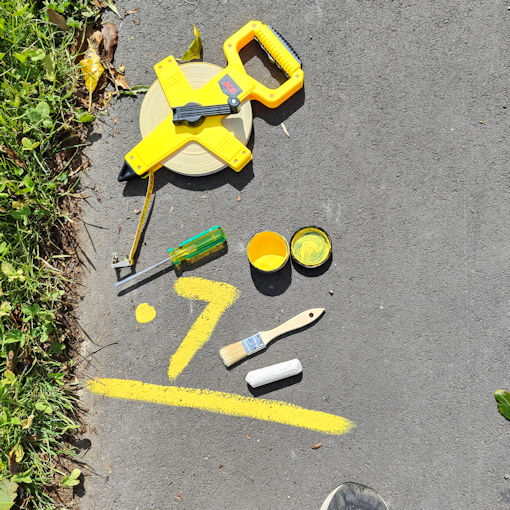
These are the simple tools I used. A 50 metre tape measure (If you can access a measuring wheel that would be easier.) a screwdriver used as a spike to hold end of the tape, chalk, a cheap disposable paint brush, and a test pot of acrylic paint. (Resene Bright Spark)
This is the sign I stapled to a pole at the start of the 600 meter path, and again here at 600 metres.
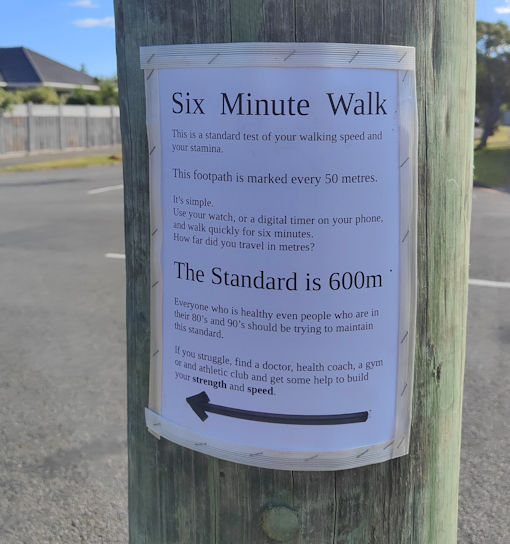
The materials used including laminating the sign should cost less that $25.00. My experience is that you can expect the paint to last about three years, before it needs a touch up. There has been some infill housing in my street and parts of the footpath have been renewed. My marks go on to the 1 kilometre mark, and in three years just 3 of my original marks needed to be replaced.
This is what they look like.
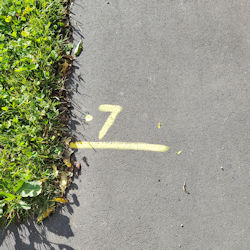
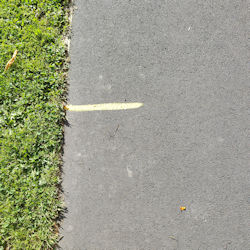
My original marks at the 700m mark for instance included the “00”. I used a “0” template to paint them. That’s extra work is difficult to do well and the solution illustrated is much easier and cleaner.
Public Support
While anyone can mark a local path in this way, I suggest that you think carefully about where you place it. You want it to be used, and you want it to be both visible, and yet not obtrusive. If you can get the support of a sports club, and incorporate paths in parks, that’s ideal.
Once you have established a measured pathway, and you can see that people use it, you might then spread the word. This is a simple health initiative, with very low cost, and high potential benefit.
In my vision, there should be a design competition for the signage and method of marking. It could be like parkrun, a recognised brand. Going further, it would be excellent if rather than everyone doing their own version, the local authority looked upon these short marked paths as a community asset, and listed them. Perhaps even offered advice to anyone or any group who chooses to do this.
Cycleways in my city, Christchurch, were once just a painted line, and they were poorly used. Today in all new suburbs, cycleways are part of the system of roads and footpaths. At considerable expense, they are also being built in the older parts of the city, as in this example, near my home.
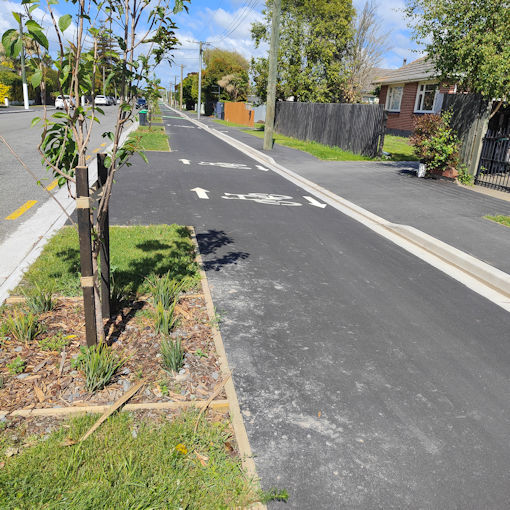
Double cycle lane in Aorangi Road Christchurch.
As this infrastructure has developed the number of people using bikes for general travel and for recreation has mushroomed. In particular the number of seniors using e-bikes has become significant. Every day you see groups of eight to twelve riders, all in high-viz gear, out on a ride that is usually 30 or 40 kilometres. The community benefit of better infrastructure is obvious.
The question is; can a bit of community effort and a little paint improve public fitness? I floated this idea, in my own cycling group. “Can you walk 600 metres in six minutes.” At least four of that group have tried, and they report “not without running”. Well, there’s nothing wrong in that, it probably reflects a lack of strength, but perhaps also a lack of speed. If you need to run, RUN and be glad you can.
The previous post is also related to this topic.